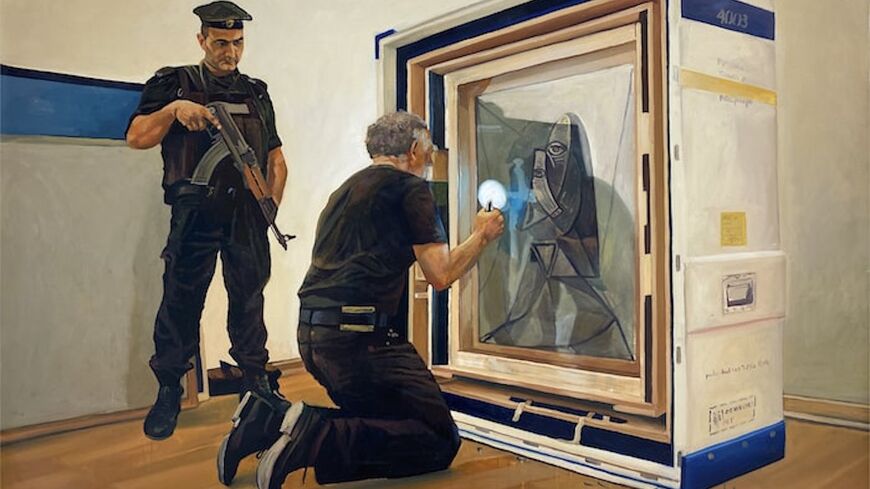
Starting Palestine’s first ever art fair during a global pandemic may seem a daunting proposition, but for Ziad Anani and Yusef Hussein, of the Zawyeh Art Gallery, it was a much needed way to bring Palestinians together in testing times.
I reported and wrote the story for Middle East Eye.
My latest piece for Middle East Monitor explores the work of Paris-based Gaza-born artist Hani Zurob.
In his latest series, “ZeftTime” the artist uses tar and broken glass to harrowing effect, as a metaphor for a shattered society. The works seems to suggest that amid tragedy there is no time to think and make up a narrative around what is happening; there is only the absolute presence of the emergency.
“This is the law of time,” Zurob points out. “Every passing moment is a new opportunity for a complete change.”
Al-Monitor has just published my interview with Libyan photographer and photojournalist Nada Harib. Her work is all about hope in the face of adversity and beauty in the midst of pain.
With her photographs widely exhibited in and outside Libya, from the Institut du Monde Arabe in France to the Tropenmuseum in Amsterdam, Harib’s work tells stories that have been forgotten or repressed during her country’s many turbulent phases.
It’s another step for me and Al-Monitor’s readers to learn more about the culture and humanity of Libya, beyond the news reports.
If you have any degree of familiarity with the history of politics and royalty in Burma, you will definitely know June Yadana as the daughter of the princess Ma Lat – the direct descendent of the last King of Burma – who later became the wife of the dictator Ne Win.
What is less known is June’s turbulent life across Europe and Asia, where she traversed the most significant moments at the turn of the twentieth century, always animated by a relentless spirit.
For months, perhaps already in October, I felt an incredible urge to look back and take stock of the entire year, to put the word end to an unfolding of events, full of beauty of pain in equal measure, and start again. But as the buds of a new life in Rome were slowly appearing, I hesitated. There was always something else to do.
One night around mid-December I felt I could wait no longer to be back in my hometown Sorrento for the holidays to put pen to paper. I had to do it right then, that Sunday night in Rome. I had just opened up my computer, when two friends called for an evening tea. To hell with it! I choose to go, choose the present life who was asking me to join in.
And now that I’m in Sorrento for the holidays, in the intersection of days where time seems to stand still, I felt some reticence to look back. I felt that since that evening tea, I have been on the other side, and looking past my shoulder at a momentous time was something blocking the appreciation of what’s right in front of me. But as I started writing, and preparing my parallel post with pictures on Gioco di Donne, I feel have digested and released the old stories, and be appreciative of where they have led me.
The question each one of us who loves art, and perhaps works in the art field must ask oneself is: with much uncertainty still looming in the upcoming year, how do artists, curators, art writers, and art appreciators keep themselves in the loop, not only growing their artistic sensitivity, but also becoming a vehicle for change towards a better society?
Global Comment has published my piece where I detail some strategies and a framework to re-articulate our approach to the art world in 2022 with renewed energy.
Singapore-based webmagazine Plural has just published my interview with Burmese painter Richie Nath, also known as Richie Htet.
In the colourfully alluring world of the artist presents us with archetypes fit for our times. His acrylics show us powerful women exuding that hard, action-focused yang energy and male characters not afraid of melting into a softer, more compassionate yin expression.
Sometimes you get the chance to delve deeper into the work of great artists only when they pass away and images of their art starts popping up here and there. This was the case for me with the ouvre of Lebanese artist Etel Adnan. I encountered her work upon her passing, and was mesmerized by it.
I quickly learned she had a life like no others, and at this point I couldn’t help myself writing about it. And I did, for Middle East Monitor. It goes without saying, when you write about art which deeply resonates with you, it’s really a blessing. The pen is aligned with the heart.
What does it mean to be Libyan? How to reconstruct a sense of belonging for the country and its people, starting from the deepest roots of Libyan culture, while preserving diversity?
These are the questions that artist, Shefa Salem, is grappling with for her first solo show I am Libya, which took place a few weeks ago in the Barah Arts and Culture Centre in Benghazi and will travel to Tripoli’s old city at the beginning of December.
I have interviewed the artist for Middle East Monitor.
The Singaporean art magazine Plural has just published my latest piece called “Is there a silver lining to the lack of tourism for the Balinese art scene?”
Here I’m interviewing the directors of three different art spaces, Cush Cush Gallery, Kayu, Ketemu and V-Room, to garner their experience with the pandemic shifts in the art scene, and how this is affecting artists and art spaces alike.
My fifth piece for Middle East Eye is about a Lebanese comic book which tells forgotten stories of country’s feminist struggle. Called ‘Where to, Marie?’, this comic book distils a century of overlooked feminist battles through the stories of five fictional characters. I have interviewed the authors.
Naima Morelli is an arts writer and journalist specialized in contemporary art from Asia-Pacific and the MENA region.
She has written for the Financial Times, Al-Jazeera, The Art Newspaper, ArtAsiaPacific, Internazionale and Il Manifesto, among others, and she is a regular contributor to Plural Art Mag, Middle East Monitor and Middle East Eye as well as writing curatorial texts for galleries.
She is the author of three books on Southeast Asian contemporary art.