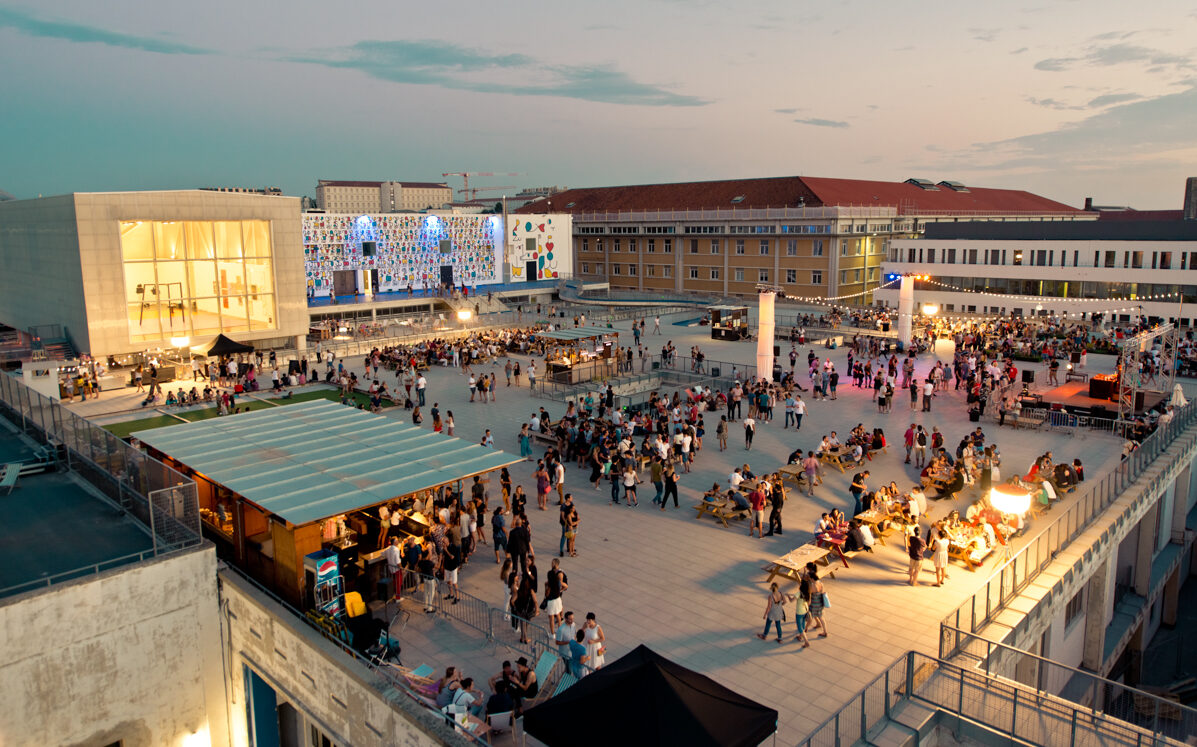
Interior Forniture and Design Magazine has published my latest article (in Italian with an English translation), a guide to my favourite city, Marseille.
Read More
Interior Forniture and Design Magazine has published my latest article (in Italian with an English translation), a guide to my favourite city, Marseille.
Read More
Below the extended version of my latest article which appeared on Le Quotidien de L’Art.
Il y a encore quelques années, la proposition culturelle dans la seconde ville de France en matière d’arts plastiques était extrêmement limitée : quelques lieux informels, des programmations éparses, un public principalement local et un marché de l’art quasi-absent.
Mais, depuis Manifesta en 2020 et grâce au travail acharné d’espaces créatifs comme la Friche Belle de Mai, et des muséums tel quel le MUCEM, le [mac] et le Frac, les propositions se sont faites de plus en plus audacieuses, attirant un public à la fois national et international. Les galeries indépendantes, plus d’une vingtaine aujourd’hui, quadrillent le centre-ville dont celles d’artistes qui ont ouvert leurs ateliers ici à Marseille, après la pandémie.
La vivacité grandissante de cette scène n’a pas échappée à l’entrepreneur culturelle Becca Hoffman de l’association 74Arts, qui organise des foires itinérantes, de Aspen à Singapour. L’Edition marseillaise de 74Arts s’appelle « La Mer, » et a l’ambition de relier directement les studios d’artistes marseillais aux grandes galeries françaises ainsi qu’aux collectionneurs internationaux. « On pense que Marseille a beaucoup changée au cours des dernières années » note Becca Hoffman, qui vit entre New York et Antibes. « Après le Covid, on a vu beaucoup de nouvelles fondations et des collectionneurs qui ont déménagés ici. Marseille, c’est l’avenir. Il y a une énergie créative qui est ouverte à tout le monde, mais surtout au Méditerranéen. »
Read More
As I walked to the museum in the southern French city, some graffiti on a restaurant shutter caught my eye: “If a place attracts you, it’s because there is something waiting for you, and your story there has already been written.”
These words stuck with me as I turned the corner and the incredible MUCEM building stood before me, epic in shape and location, silhouetted against the cloudy sky, seemingly suspended on the sea.
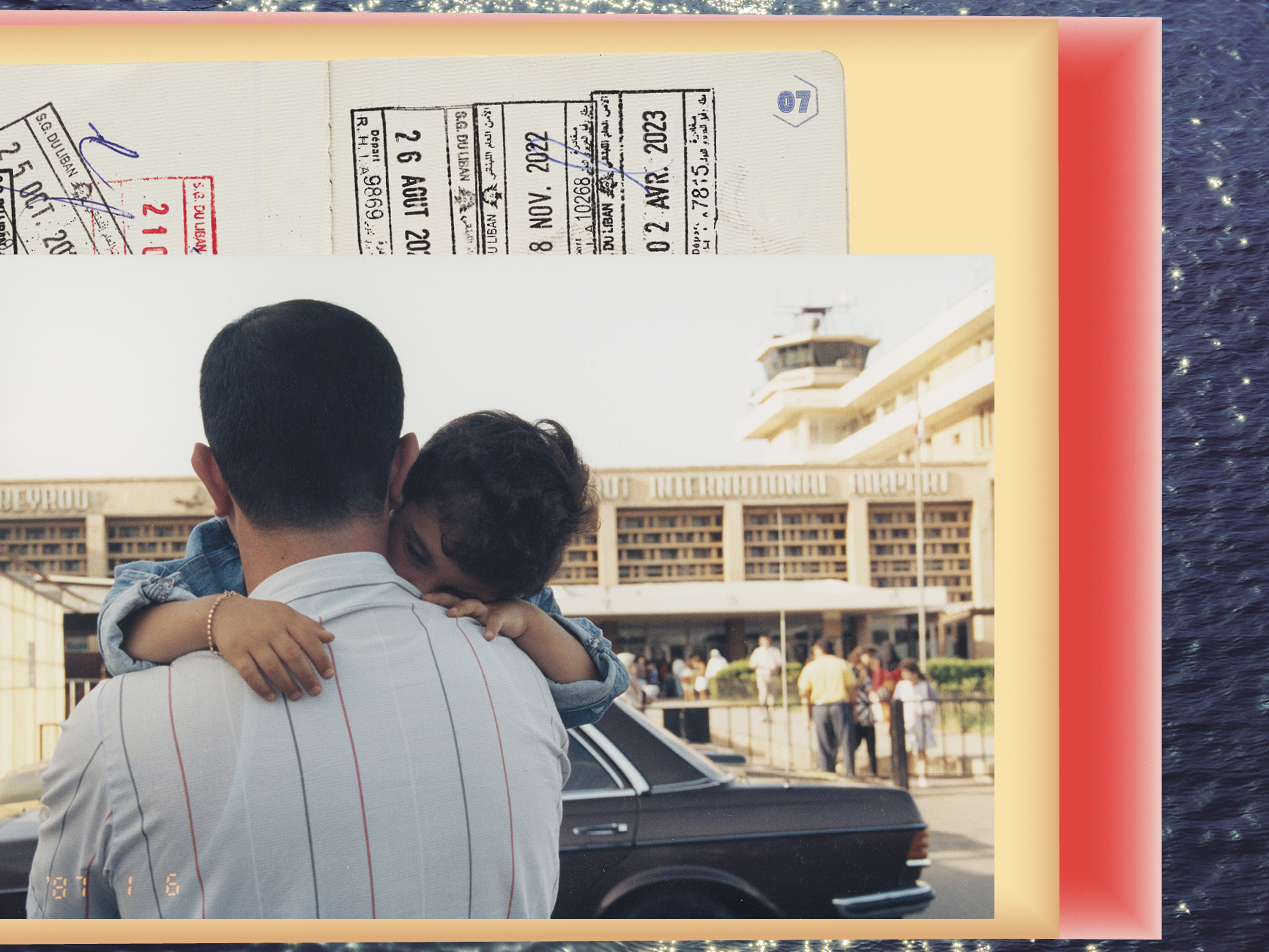
“Revenir” focuses on the idea of home, travel and returning. This is not only the scope of the show, but the wider project of the museum, which is dedicated to Mediterranean cultures, especially to that very specific blend for which this city port is renowned.
Running until 16 March at the Museum of European and Mediterranean Civilisations (MUCEM) in Marseille, the exhibition “Revenir” (“Return”) invites visitors to explore the experiences of returning to one’s homeland.
I wrote about the show for Middle East Monitor.
Here is the link to the review
Read More
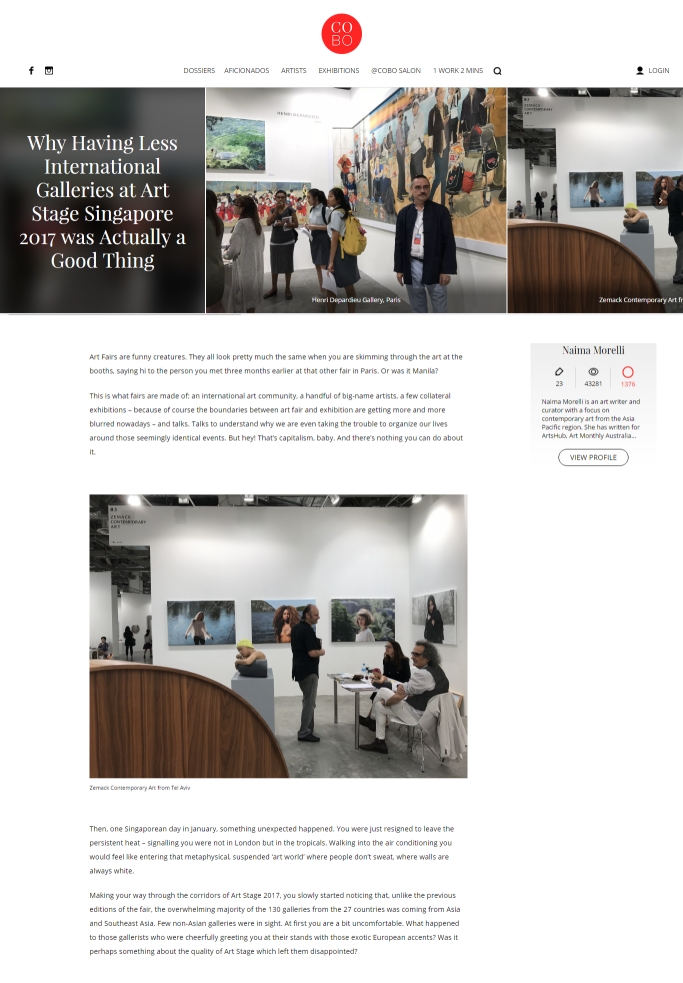
We’ve all heard the joke about art lovers who don’t necessarily celebrate Christmas and Easter, but they definitely celebrate Frieze and Art Basel. This ritualistic aspect of the art world hasn’t escaped Asia NOW, whose tenth anniversary show is aptly titled ‘Ceremony’.
Guided by the ethos of positioning itself not just as another art fair, but as a curated platform presenting Asia to a European audience, Asia NOW has chosen the artistic direction of Radicants, the curatorial cooperative founded by Nicolas Bourriaud, for its main exhibition.
I have written about it for The Art Newspaper France.
Here is the link to the article
Read More
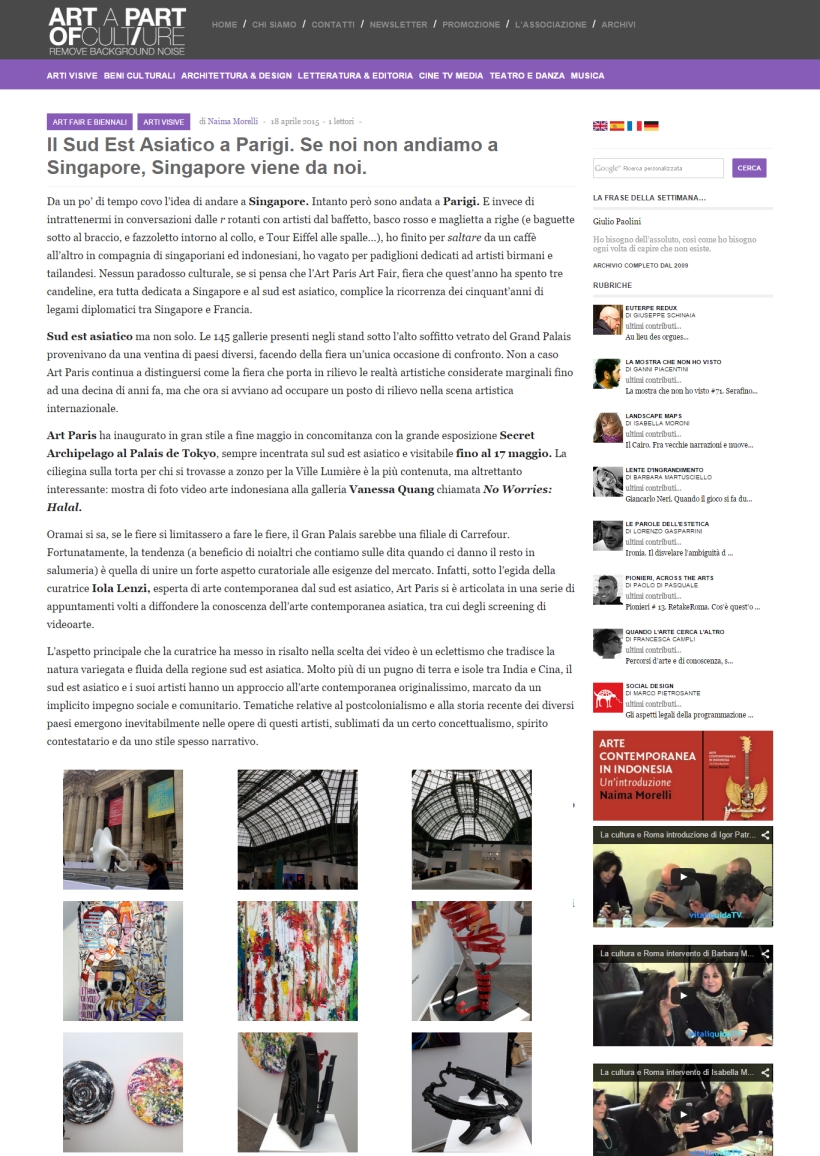
This summer I visited for the first time Marseille, to do a little research on the comic book scene there. I have found an incredible lively scene, which provided me with many insights about art, life, and how a community comes together around shared values.
I wrote the piece in Italian for the webmagazine Art a Part of Culture.
Here is the link to the article
Read More
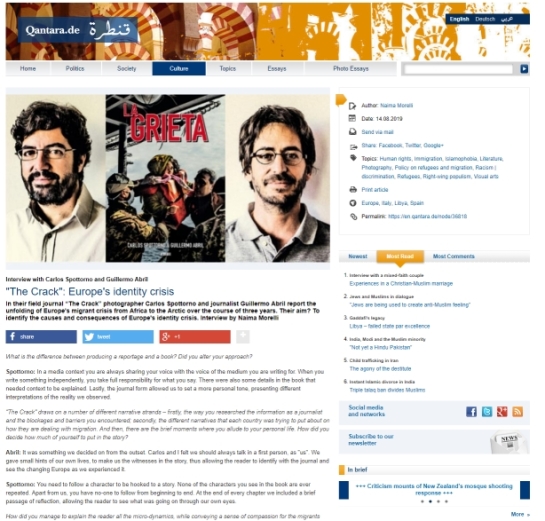
In their wonderful graphic novel/field journal “The Crack” photographer Carlos Spottorno and journalist Guillermo Abril report the unfolding of Europeʹs migrant crisis from Africa to the Arctic over the course of three years. Their aim is to identify the causes and consequences of Europeʹs identity crisis.
I have interviewed the two reporters for Qantara, a webmagazine promoting cultural exchange, based in Germany. I’m super-excited because of this new collaboration, which allows me to bring back my explorations in foreign realities back to my homeland Europe.
Here is the link to the interview
Read More
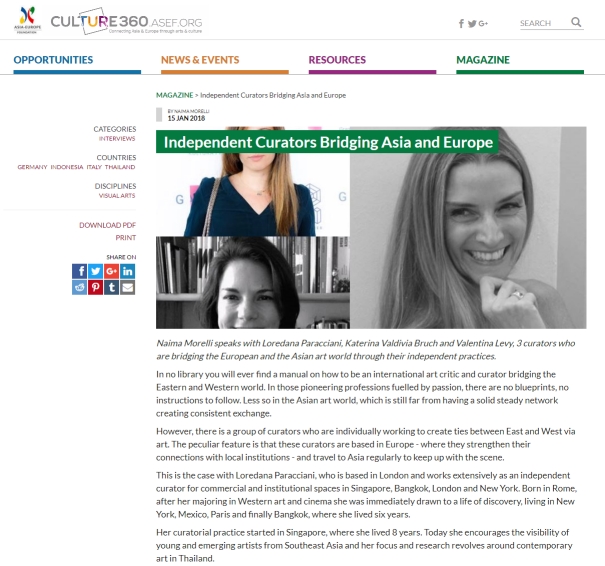
Culture360 – the webmagazine of the Asia-Europe Foundation – has just published my piece on independent curators bridging Asia and Europe (and also other parts of the world) through contemporary art.
I have met these three incredible women in several occasions; they are doing a very important and necessary work, filling gaps in understanding across cultures. Their practice and professional rigour inspires me greatly.
Read More
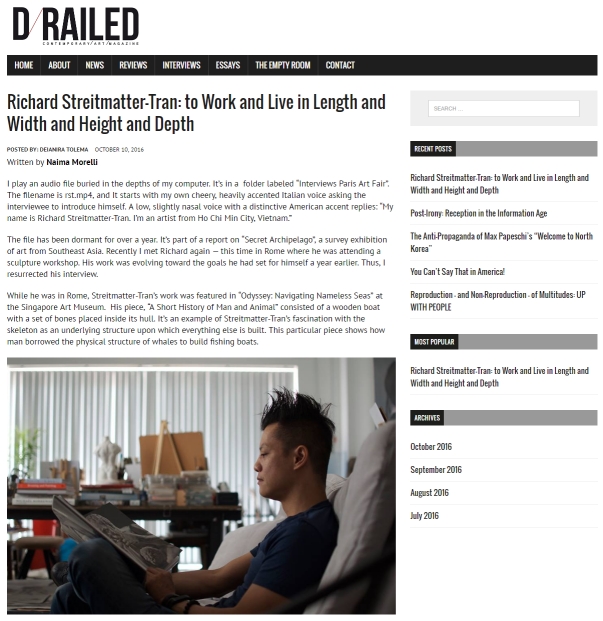
Since I have started writing about contemporary art for magazine – around 2007 – I have collected a number of interviews. Some have been published straight away, others have been used later on as sources for articles or in books. Then there are all the others that have never been published, and are part of my personal archive, informing every word I write.
Every now and then, I decide to pull an interview out of the archive, like this one with Richard Streitmatter-Tran, who I have met and interviewed first in Paris at the Palais de Tokyo, then in Rome, where he was attending a sculpture workshop. The new art magazine I’m collaborating with, D/Railed by Deianira Tolema, was the perfect home for the piece.
Here’s the link to the interview
Read More
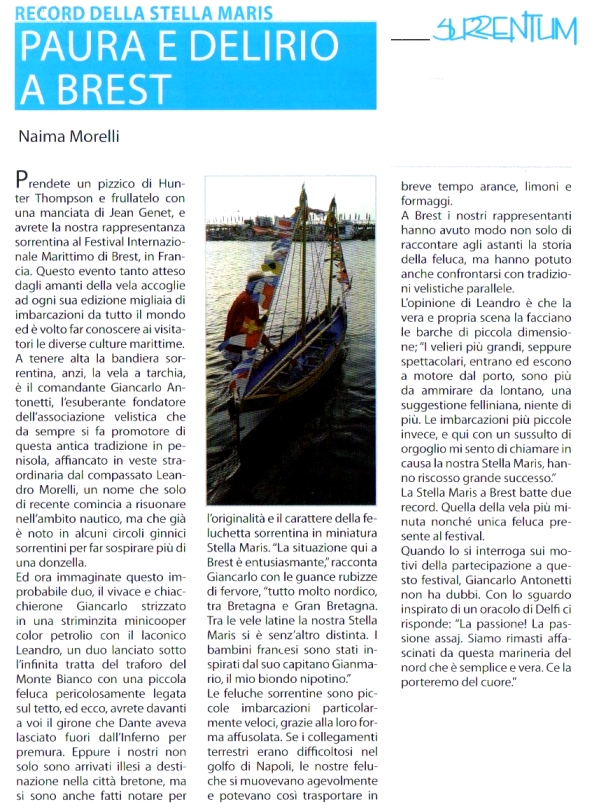
Among the art pieces I write each month, every now and then I churn out a funny one. This time the Sorrento local magazine Sorrentum was looking for a short write-up about the participation of the miniature sail boat Stella Maris and its team of two to the annual maritime festival of the French city of Brest (the same one of Jean Genet’s “Querelle de Brest”). Half of the team was Capitain Giancarlo Antonetti – a super-chatty sea dog and certifiable nuts – and the other was my brother, who is by far the sternest and most taciturn person I have ever met.
In the article I imagined the two-days long car trip of the two from Italy to France. You can read the piece on the August issue of Sorrentum or, more straightforwardly, below. It is in Italian, but the title can translate as “Fear and Loathing in Brest”
Paura e Delirio a Brest
Prendete un pizzico di Hunter Thompson e frullatelo con una manciata di Jean Genet, e avrete la nostra rappresentanza sorrentina al Festival Internazionale Marittimo di Brest, in Francia. Questo evento tanto atteso dagli amanti della vela accoglie ad ogni sua edizione migliaia di imbarcazioni da tutto il mondo ed è volto far conoscere ai visitatori le diverse culture marittime.
A tenere alta la bandiera sorrentina, anzi, la vela a tarchia, è il comandante Giancarlo Antonetti, l’esuberante fondatore dell’associazione velistica che da sempre si fa promotore di questa antica tradizione in penisola, affiancato in veste straordinaria dal compassato Leandro Morelli, un nome che solo di recente comincia a risuonare nell’ambito nautico, ma che già è noto in alcuni circoli ginnici sorrentini per far sospirare più di una donzella.
Ed ora immaginate questo improbabile duo, il vivace e chiacchierone Giancarlo strizzato in una striminzita minicooper color petrolio con il laconico Leandro, un duo lanciato sotto l’infinita tratta del traforo del Monte Bianco con una piccola feluca pericolosamente legata sul tetto, ed ecco, avrete davanti a voi il girone che Dante aveva lasciato fuori dall’Inferno per premura.
Read More
Published! Why satire should come of age on Global Comment
Global Comment has just published my article titled “It’s not just a cartoon: why satire should come of age”. Writing for Global Comment gives me the chance to get a little bit out of my comfort zone, writing about topics not necessarily related to contemporary art and – like in this case – making reflections and drawing connections to the news of the day.
In this piece I’m referring to the parallel upheavals caused by Charlie Hebdo’s cartoon on the earthquake in Italy and The Australian’s cartoon of the Aboriginal dad. While coming from different contexts, both caused a stir. I’m looking at why this happened, and how satire should take into consideration in a modern, more complex world.
Here is the link to the piece
Read More