My review of the show “The Utopia of Rules”, which I saw at the Singapore Art Week at the beginning of the year, has been published in the latest issue of Mekong Review.
Here is the link to the article
Read More
My review of the show “The Utopia of Rules”, which I saw at the Singapore Art Week at the beginning of the year, has been published in the latest issue of Mekong Review.
Here is the link to the article
Read More
Geraldine Kang
Earlier we have introduced the work of Singaporean artist and photographer Geraldine Kang. When I first came to Singapore for a month-long immersion of interviews and visits to art spaces, she was the first one among the artists I had planned to speak with. The intuition was good. Alongside allowing me to deepen my knowledge of her work, she also gave a good insight into the working conditions of the younger generation of Singaporean artists, their peculiar outlook and their experience in the art world. Geraldine was also teaching at LaSalle — we indeed meet in the school café — so she gave me a first hint of awareness of the conditions of the still-students, the yet-to-become-artists.
Read More
Adeline Kueh
“What gets measured gets managed,” wrote Peter Drucker, the founder of modern management. And the struggle of measuring what is imponderable is one of the shapes that the contrast between bureaucracy and spirit takes shape. In this context, we have seen how there are those giving breath to a life in a country which is all about achievement and “getting there”. If this attitude of bringing home results has proved successful for the city state, artists are those who need to rebalance the machine with a ghost. To give humanity to the clog.
Artist Adeline Kueh belongs to those who are able to give shape to feelings that you can’t simply calculate on a spreadsheet. Her sensitivity is attuned to the appreciation of beauty, and she finds it in the memories, in the history of people, places and objects. I meet this pretty, tiny and brisk woman in the Lasalle cafè where she works as an art educator. Every project she starts comes from a personal place, and has memories and meaning attached to it. She looks with a romantic and poetic eye at themes which can be considered quite risqué (she loves to drop a French word here and there — perhaps from her living in Canada as a young student, perhaps from her wide-ranging readings).
Read More
Nature in Singapore
The garden city utopia was conceived well before Singapore would reclaim this title for itself. The term was first created in 1898 by utopian thinker Ebenezer Howard. The concept of having housing outside the city, providing to each house its own garden, was made possible by the brand new railroad, which made transportation possible. Again, it was a way to go home, away from the industrial pollution. This idea was successfully implemented in Anglo-Saxon countries. In the US especially, this sort of nuclear family solution came to correspond with the American dream.
As we mentioned earlier, suburbia proved problematic not only on a social level. There are also other problems involving a shortage of horizontal space, and most importantly, the transportation which made possible the idea of garden city must today be reduced for environmental reasons. Today’s transportation calls for a different conception of the garden city, a garden city that is mainly vertical, and that is what has been implemented by Singapore. In its modern idea of the Garden City, Singapore wants to show that nature and business can be integrated. The western division between leisure and work doesn’t have to be so sharp. Business life doesn’t have to necessarily happen away from nature, and be balanced by it. This corresponds, on a wider scale, to the dismantling of the idea of work-life balance, as if work and life would be two separate entities. What is valid for the individual is valid also for the wider community. It is true that there is a place to sleep, a place to work, a place to relax, but we must keep in mind that in our mind and life the boundaries are not so strict as walls.
Read More
Daylight dystopia
In our worse dystopian imagination, brought to fruition by filmmakers and artists, we imagine the cities of the future being an endless continuation of buildings and city lights, from the steamy Metropolis to – moving to the ‘80s – the cities of Ghost in The Shell, or Neon Tokyo from Akira. Asian mega-cities provided a good model in this respect. The urban landscape of Blade Runner for example was inspired by a particular part of Kwaloon, also known as the Walled City. This was an area of incredible density, a human anthill, picturesque and inhuman at the same time. In 1994, Kwaloon was demolished. Visitors eager to see the ruins of this mythical place will instead find a park with gardens, floral walks, ponds and pavilions. The future was not as we imagined, if not only for the lack of flying cars which many of us lamented, but also because it doesn’t look as evil as we thought. Then came the daylight dystopia. As a child, I remember approaching this slightly less suffocating concept in the Disney PK comics. This was a superhero series of Donald Duck set in a futuristic future. In a particular episode, PK travelled to the future to find that instead of the tower he operated from – the Ducklair tower created by a tech genius – there was a garden. Our beloved flying cars came in handy in that comic in order to reach the heights of that vertical city, whose buildings have gardens on top, another idea which is being implemented in the green architectural world. An idea that has been developed by many architectural firms reimagining the future of the urban landscape as we will see. The palaces of the old city will be pillars, or comprised into other buildings, and of course we have plenty of examples of this as well. The final look of this city is a green aspirational environment which will preserve history and won’t look as dingy and ugly as we imagined dystopian cities to be.
Read More
The work of Geraldine Kang
For Geraldine Kang, art-making has the functions of helping her process her thoughts and feelings and to get herself out of her head. In the awarded series ‘In the Raw’, she depicted her family members in surreal situations dealing with nudity, aging and death. The artist defines In the Raw as a “shock treatment” to introduce her parents to her art practice, which in the beginning they didn’t understand. In an iconic picture of her series, she is in bed with her parents, just like a little child would do, but with a photographic book showing breasts. The photographs encapsulate the lack of intimacy and the difficulty of maturing and dealing with desire where you share the same living space with your family.
Read More
HDB
“Yearning is the dominant theme that runs through all of my work,” said the outstanding photographer Nguan to The Straits Times. “Singaporeans are restless by nature – we have wandering hearts. This picture describes the longing to be in a different place or time.” Nguan is probably the artist who best caught the poetic, ineffable, paster colour heat of Singapore. In his delicate photographs, depicting mundane moments, suspended in silence, he is able to capture the soft alienation of his own city.
Read More
Zihan Loo
At the end of 2015, I was wandering around SAM8Q looking for the proverbial exit through the gift shop — as Banksy would put it. I wanted to buy some books to bring back home with me. At the ground floor of the building there was something that appeared to be what I was looking for. Shelves of interesting books, and a few on exhibition. I was thrilled. When I walked in, something was not quite right. I asked the person at the desk: “I’m sorry, this is not the museum bookshop, it is an artwork.”
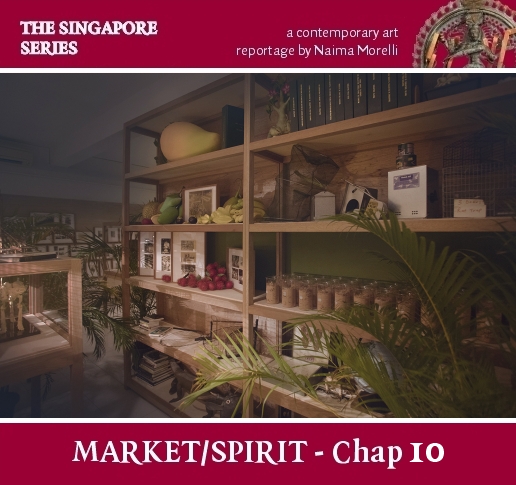
Damn! This is precisely what I’m talking about when I speak of the problem with contemporary art. The work, he explained, was done by artist Zihan Loo, and was called “Of Public Interest: The Singapore Art Museum Resource Room”. The artist moved 4,500 volumes from the Singapore Art Museum’s resource room — currently not available to public — into the space of a gallery. The public were invited to shape the collection for the duration of the exhibition from August 2015 to March 2016. The conditions were that each visitor was allowed to withdraw one book from the collection, restricting the public access to this book for the duration of the exhibition. These books were shrink-wrapped and placed in a separate area of the installation.
Read More
Funding Shaping the Work of Artists
Let’s go back to The Substation for a second. We mentioned that when the space started in 1990, it was the very first art space in Singapore, before SAM, before the Esplanade and much earlier than the National Gallery. In the narrative of the local art world, the existence of this place encouraged many people to gather to appreciate and make art, music or writing in a way that couldn’t be found anywhere else in Singapore. This was a sign for the government, who acknowledged the situation, observed a spontaneous surge of creativity and cultural momentum, and decided it was high time to open up an art museum five years later. “We were actually forcing to government to shape policies in some way last time,” said Alan Oei during our conversation: “But once they shaped the policies, we kind of have been sucked into their policies and we haven’t made them change anything for a long time.”
Read More
Brother Cane and the Josef Ng Affair
Given the big scandal his case provoked, you would imagine Josef Ng holding resentment to his country Singapore in one way or another. This is not at all the case. After two decades of auto-exile, working as a curator in Bangkok and Shanghai as gallery director, in December 2015 the artist and curator went back to Singapore, hired by the gallery Pearl Lam. As a young man, Josef was part of the Artist Village. It was a time when, as we saw earlier, there was almost no funding for art, and artists were making art for their own pleasure, with a particular focus on performance. Over time, the performers started carving some space for self-expression, and became bolder and bolder, eliciting some reactions. A pioneer of subversion in Singapore was Vincent Leow, who made an operation à la Manzoni, without even knowing of the precent, bottling his urine.
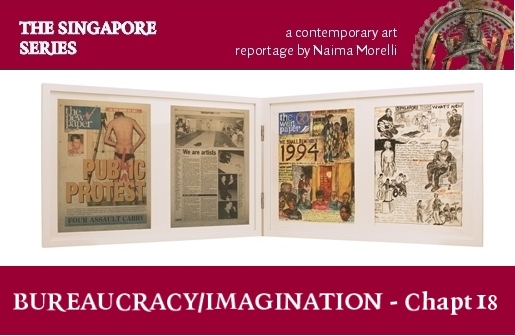
However strange all of those performances looked for the Singaporean public at the time (and I suspect even today), the real deal happened during the performance “Brother Cane” by Josef Ng in 1994, at Parkway Parade. The performance was conceived as a protest against the arrest and caning of twelve homosexual men, and consisted of caning slabs of tofu. Then the artist turned his back to the audience and snipped off some pubic hair. Here is the recollection of Professor of Live Art and Performance Studies Ray Langenbach:

Audience anxiety
In 2017, I visited a show a of ceramic artist Iskandar Jalil, in dialogue with the young Singaporean artist Gerald Leow at the National Gallery of Singapore. Gerald’s day job was set design, and it showed from his intervention in the show, which was very subtle. He built a metal structure evoking the traditional house of Inskandar with a simple metal outline. I was looking forward to seeing the show since the artist mentioned that he was doing research from it in our first interview, and I peered out curiously into the room. Before I had the chance to set foot inside, the gallery sitter, gentle as ever, handed me a flyer: “Please find here some information about the show. You will find also the interview of the curator with Gerald Leow and some information about the content of the show. Please proceed to your left to see the exhibition.” Being a Neapolitan, so a rule-breaker by nature, I was about to blurt out: “Well, what if I want to start from the right?” After all, there was no chronology intended in the work, and there were no other people in room. But instead, I shut up and remembered where I was. And yes, I was in a place where the so-called audience anxiety was real.
Read More
The norm and the individual
My curator friend Roberto D’Onorio and I have very different tastes when it comes to historical figures. I have always been all about the bat shit crazy personalities such as Caligula – which obviously attracted me for their romanticism, their “freedom in their own psychosis”. Conversely, Roberto has always been all about the composed, formal figures, among which his favourite is the Queen Elizabeth II.
He doesn’t just like her. He’s crazy about her to the point that he watched all the documentaries about her, all the series and of course the movie “The Queen”. What he likes about her is that she, unlike her other contemporaries such as Churchill or Margaret Thatcher – who by the way was referred to as having the lips of Marylin Monroe and the eyes of Caligula – was a sane individual in a system which required her to be there.
She didn’t have to make any kind of choice, she just had to follow a protocol which was already laid out for her. She just needed to embody it in the best way possible, and adapt her personality to it. As Roberto pointed out, Elizabeth was a sane individual operating in a system that catered to her. The system itself was something that had no reason to exist other than to keep power structures in place. And that brings us to talk about Singapore and its artists.