Naima Morelli

Archive
Tag "singapore contemporary art"

cover8

Economic Agenda for the Arts

In the beginning, when people were talking to me about art in Singapore, I was hearing two parallel stories. In one of these two stories, the art was born from individuals who dared to go against the grain, challenge the status quo, coming together to build a community. The other story was that the government decided they needed art, and so they made it happen. I slowly realised that it wasn’t merely a different point of view. Contemporary art in Singapore was twice born.

The first time it was a natural birth. Grassroots. Tang Da Wu, Lee Wen, Amanda Heng, Vincent Leow, Suzanne Victor were among them. Names inextricably associated with the early days of The Artist Village. The second was more of cesarean section. My midwife housemates explained to me how differently these two worked. In the natural birth, it’s all up to the mother. There is a lot of suffering involved, but that suffering is good, because the mother instinctively knows where to push, which position to take to get the baby out. It’s her bodily knowing, no one else can tell her how to do it. It’s the most natural thing in the world, although it might be dangerous. Back in the day, giving birth could often result in the death of the mother or the baby, or both. But when it was done – my midwife housemates assured me – it was about the most beautiful feeling in the world. The mother could finally take in her arms that ugly purplish sticky thing which is a newborn baby and feel completely happy, serene, fulfilled and relieved on the most existential level. Well, that was The Artist Village. Little money from the government, all going forward with a day job and a lot of opposition from family and society. The first attempts might have looked ugly like a newborn baby, but the love was definitely there, and the satisfaction for creation too. They must have felt that they were really up to something. In hearing about people telling about those pioneer times, you’d feel the quiet heroism.

Read More
cover7

Just go to Thailand!

Back in Singapore after my first trip, I participated in a talk at the art space The Substation about the current exhibition in place. The idea of a book about Singapore contemporary art was starting to take shape in my mind. at the time, and I came back for another month-long research. This time around, I wanted to focus on capturing the spirit in which the artists were producing work, as well as understanding the core concerns of curators and art operators. In the long and narrow room of The Substation art space, I recognised a few people coming together to start the talk. One of these was The Substation director Alan Oei, one of the first people I interviewed in Singapore and the person who gave me a comprehensive vision of what was going on.

Alan Oei is the kind of person who attracts polarising feelings because of his clear-cut ideas, critical attitude and strong charisma. This is something quite common in the Italian art world, where art critics and curators like to challenge audiences – think of big personalities like Philippe Daverio, Achille Bonito Oliva or Vittorio Sgarbi – but in Singapore and Southeast Asia, where moderation is the norm and the art world is still too small to overtly create factions. This is quite uncommon. Perhaps because of my background, I personally liked Alan Oei’s attitude a lot (not that I necessarily agreed with his opinions). I liked him the way one can like romantic characters. Those who have real vigour in bringing forward their ideas, and a strong spirit to led them. Believing his own ideas to a fault.

Read More

stephaniefong
To Stephanie Fong, founder and director of FOST Gallery in Singapore, the job of a gallerist is not just about selling the art, but rather providing an experience. With an uncontainable passion for culture, as well as an eye for the evolving trends worldwide, Stephanie has become a point of reference in the Lion City’s art scene.

I had the pleasure of talking with Stephanie for CoBo Social during my last visit to Singapore a couple of months ago, and I found he combination of strenght and grace – in both her personality and in the way she runs her business – incredibly inspiring:

“Why are you doing this?” She laughed and replied almost immediately: “I think at the core of it it’s what I’m meant to do. Now looking back at my journey, it all made sense, even though I hadn’t really planned it that way. Maybe it has been all about faith.”

Here is the link to the interview


Read More

audrey_yeo

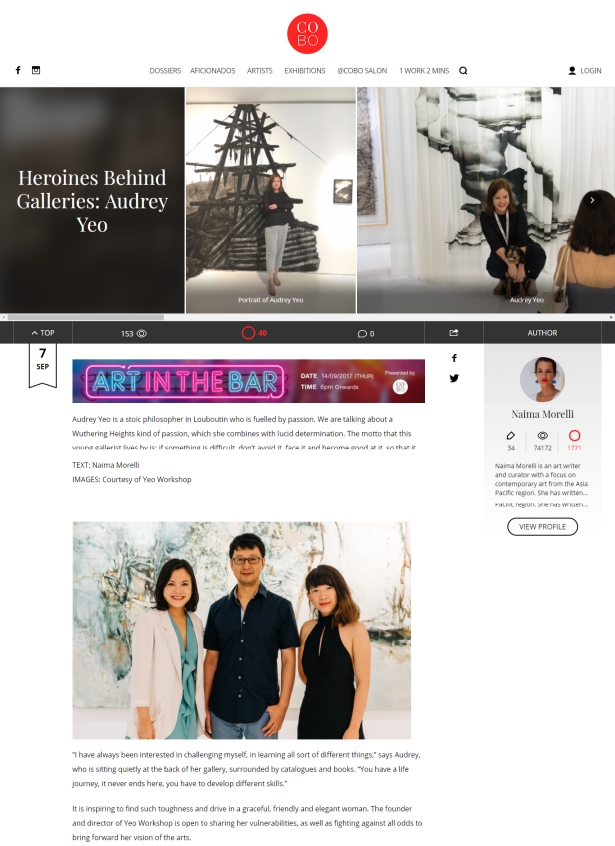
CoBo has just published my interview with gallerist Audrey Yeo, director of Yeo Workshop in Singapore. I realized the interview a few months ago and it was greatly inspiring to talk with such an important igniter of the Singaporean art scene.

Here is the link to the interview

Read More

artshub14

Lovers, friends and family have always been the favourite source of inspiration for artists since the beginning of times. Of course, these involuntary muses are not always happy of being turned into characters of a story, or having their portrait on a gallery wall. This especially if the art deals with intimate, personal and potentially embarrassing themes.

Back in the day the artist could hope the subject matter was unaware of being included in the work. Today though it’s virtually impossible. An image or a review can be infinitely shared on social media. At the same time gallery access is not just for the elites anymore.

I this piece, which has just been published on ArtsHub, I discuss the ethics of including other people’s life in art with artist Geraldine Kang and writer Michele Lee.

Here’s the link to the piece

Read More

artshub13

Australian magazine ArtsHub has just published my latest piece where I profile three Australian art professionals who are leaving their mark on the Singapore art scene. These are Ben Hampe, co-founder of Chan Hampe Galleries, Bala Starr from the Institute of Contemporary Arts Singapore at LASALLE and artist Belinda Fox. This piece is part of my reportage on contemporary art in Singapore.

Here’s the link to the piece

Read More

book
I’m a big fan of reading how writers organize their research and how they put their books together. I figured it would be interesting to detail the way I’m working at my new book on young artists in Singapore. In this post I’ll walk you through the first few stages from the preliminary research to the first draft.

First phase: preliminary research.  I read articles about Singapore art scene and books on Singapore urbanism, political and economical situation. I interviewed Lee Wen when he was in Rome, I met up with Italian artists who went to Singapore on a residency, and talked to a couple of Singaporean curators visiting Italy, included Paul Khoo. I stayed two weeks in Paris for the Singapour en France event, composed by the Paris Art Fair and the exhibition “Secret Archipelago”. In both case I interviewed artists, curators and gallery owners. Back home, I talked with via skype to other Singaporean artists, mainly for magazine articles. Finally, I went to Milan to visit the exhibition “Bright S’pore” at Primo Marella gallery and saw some works in person.

Read More

1
My series on studio visits is finally back! During my reportage in Singapore I had the chance to snoop around the working and sometimes also living space of local artists. First up is a wonderful Italian artist who now calls the Lion City home: Giada Tagliamonte aka Zada Tagli. Her work is delicate and poetic, and although she’s inspired by eminent figures of Italian culture, such as Giotto and Umberto Eco, the imaginary she evokes is really universal.  You will soon read my interview to her, which I realized in November – but for now I’ll let the images speak for themselves.

Read More

pascal_martin_tajou
This is a public service announcement (with guitar! As the Clash would say); I’m working on a new book. It will revolve around my research on contemporary art in Singapore and will explore some concepts I started looking at in my previous book, Arte Contemporanea in Indonesia, un’introduzione.

Of course, having a second “baby” might look easier if you already had that kind of experience. But a second book comes with its new challenges. On top of that, I also had an aborted book which still is very much a looming presence. (Should we stop once and for all with these stupid baby metaphors when talking about book projects?)

Read More